
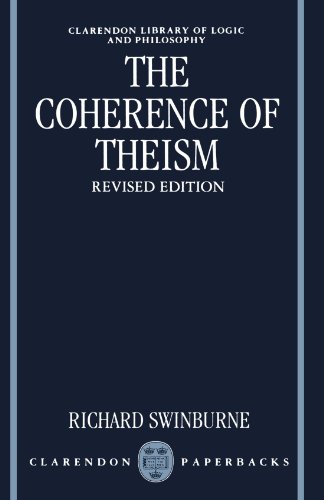
The coherence of theism / by Richard Swinburne.
Material type: TextPublisher: Oxford, United Kingdom : Oxford University Press, [2016]Copyright date: ♭2016Edition: Revised editionDescription: 312 pages ; 23 cmContent type:
 - text
- unmediated
- volume
- 9780198240709 (pbk)
- 0198779690
- 9780198779704
- 0198779704
- 211.3 Swi 1993 23
- BT130 .S94 2016
| Item type | Current library | Call number | Status | Barcode | |
|---|---|---|---|---|---|
 Books
Books
|
Ethiopian Graduate School of Theology Library Available at Circulation Section | 211.3 Swi 1993 (Browse shelf(Opens below)) | Available | 19738 |
Includes bibliographical references and index.
Conditions for Coherence: Logical Possibility -- Conditions for Coherence: Metaphysical Possibility -- The Words of Theology: 1. Words with Old and New Senses -- The Words of Theology: 2. Medieval and Modern Accounts -- Attitude Theories -- An Omnipresent Spirit -- Free and Creator of the Universe -- Omnipotent -- Omniscient -- Perfectly Good and a Source of Moral Obligation -- Eternal and Immutable -- God's Necessary Properties -- A Necessary Being -- Holy and Worthy of Worship.
"The Coherence of Theism investigates what it means, and whether it is coherent, to say that there is a God. Richard Swinburne concludes that despite philosophical objections, most traditional claims about God are coherent (that is, do not involve contradictions); and although some of the most important claims are coherent only if the words by which they are expressed are being used in analogical senses, this is the way in which theologians have usually claimed that they are being used. When the first edition of this book was published in 1977, it was the first book in the new 'analytic' tradition of philosophy of religion to discuss these issues. Since that time there have been very many books and discussions devoted to them, and this new, substantially rewritten, second edition takes account of these discussions and of new developments in philosophy generally over the past 40 years. These discussions have concerned how to analyse the claim that God is 'omnipotent', whether God can foreknow human free actions, whether God is everlasting or timeless, and what it is for God to be a 'necessary being'. On all these issues this new edition has new things to say."-- From the publisher.
There are no comments on this title.