
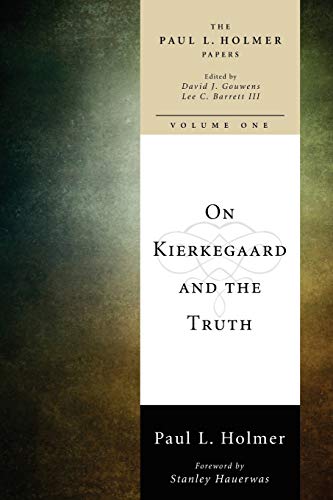
On Kierkegaard and the truth / by Paul L. Holmer ; edited by David J Gouwens and Lee C Barrett III ; foreword by Stanley Hauerwas ; afterword by David Cain.
Material type: TextSeries: The Paul L. Holmer Papers | Paul L. Holmer PapersPublication details: Eugene, Or. : Cascade Books, c2012.Description: xxvii, 314 p. : port. ; 23 cmISBN:
 - 9781608992720 (pbk)
- 1608992721
- 198.9 Hol 2012
- B4377 .H65 2012
| Item type | Current library | Call number | Status | Barcode | |
|---|---|---|---|---|---|
 Books
Books
|
Ethiopian Graduate School of Theology Library Available at Circulation Section | 198.9 Hol 2012 (Browse shelf(Opens below)) | Available | 16805 |
"Paul L. Holmer : a select bibliography": p. 299-301.
Includes bibliographical references (p. 303-307) and indexes.
An introduction to the problem -- A glance at a contemporary effort in Danish philosophy -- A new way of philosophizing -- The Bible and Christianity -- History and the sciencens -- Truth is subjectivity : some radical criticisms -- Truth is subjectivity : some logical considerations -- Some epistemological questions -- Kierkegaard and metaphysics -- Kierkegaard and the nature of philosophy -- Indirect communication -- Kierkegaard and the sermon -- Faith and Christianity.
Paul L. Holmer (1916-2004) was Professor of Philosophy at the University of Minnesota (1946-1960) and Noah Porter Professor of Philosophical Theology at Yale Divinity School (1960-1987). Among his many acomplishments, Holmer was one of the most significant American students of Kierkegaard of his generation. Although written in the 1950s and 1960s, Holmer's theological and philosophical engagement with Kierkegaard challenges much in the contemporary scholarly discussions of this important thinker. Unlike many, Holmer refuses reductionist readings that tie Kierkegaard to any particular "school." He likewise criticizes biographical readings of Kierkegaard, much in vogue recently, seeing Kierkegaard rather as an indirect communicator aiming at his reader's own ethical and religious capacities. Holmer also rejects popular existentialist readings of Kierkegaard, seeing him as an analyzer of concepts, while at the same time denying that he is a "crypto-analyst." Holmer criticizes the attempt to construe Kierkegaard as a didactic religious thinker, appreciating Kierkegaard's "cool" descriptive objectivity and his ironic and stylistic virtuosity. In his important reading of Kierkegaard on "truth," Holmer pits Kierkegaard against those who see "truth" empirically, idealistically, or relativistically. Holmer's carefully textured account of Kierkegaard's conceptual grammar of "truth" in ethical and religious contexts, fifty years after it was penned, addresses immediately current discussions of truth, meaning, reference, and realism versus antirealism, relativism, and hermeneutics. It will be of great interest to all interested in Kierkegaard and his importance for contemporary theology and philosophy.
There are no comments on this title.