
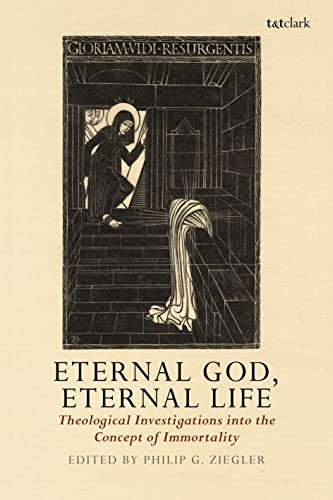
Eternal God, eternal life : [manuscript] : theological investigations into the concept of immortality / edited by Philip G. Ziegler.
Material type: TextPublisher: London Oxford : Bloomsbury T& T Clark, 2016Copyright date: ♭2016Description: xi, 215 pages ; 24 cmContent type:
 - text
- unmediated
- volume
- 9780567684516 (pbk) :
- 0567666832 (hb)
- 9780567666840 (epdf)
- 0567666840 (epdf)
- 9780567666857 (epub)
- 0567666859 (epub)
- 236/.22 23
- BT921.3 .E84 2016
| Item type | Current library | Call number | Status | Barcode | |
|---|---|---|---|---|---|
 Books
Books
|
Ethiopian Graduate School of Theology Library Available at Circulation Section | 236.22 Ete 2016 (Browse shelf(Opens below)) | Available | 20849 |
Includes bibliographical references and indexes.
1. The Order and Movement of Eternity: Karl Barth on the Eternity of God and Creaturely Time / Tom Greggs -- 2. 'You Are Good and Do Good' - Some Remarks on Eternal Life and the Goodness of God / Christopher J. Holmes -- 3. The Resonating Body in Triune Eternity / Markus M hling -- 4. Angels and Immortality / Donald Wood -- 5. How New is New Creation? Resurrection and Creation ex nihilo / Susannah Ticciati -- 6. Towards a Doctrine of Resurrection / Katherine Sonderegger -- 7. The Enmity of Death and Judgement unto Life / Philip G. Ziegler -- 8. Eucharist and immortality: Reformed Reflections on the Eschatological Dimension of the Sacrament / Paul T. Nimmo -- 9. 'The Incompleteness of the Completed': Eternal God, Eternal Life and the Eternal Now / Russell Re Manning -- 10. Technological Immortalization and Original Mortality: Karl Barth on the Celebration of Finitude / Robert Song.
How ought Christian faith and theology understand the concept of human immortality today? And what, if anything, might be distinctively Christian about such a concept? The contributors to this volume explore how our thinking about the prospect of human immortality is decisively determined by what we receive of the limitless life of the triune God of the gospel, and how our understanding of immortality is made concrete by the Christian hope in 'the resurrection of the body and the life everlasting'. Debates about how best to understand the eternal life of God are directly significant to how we can imagine the promise of eternal life. While immortality is generally conceived to be a future qualification of human reality, theological approaches to the question of personal immortality must investigate the difference that the hope and promise of such eternal life makes in the living of present-day spiritual life as well as in our common moral and political existence. To understand immortality as an eschatological gift of God requires that we take account of it as a formative factor at the foundations of the Christian life.
There are no comments on this title.