
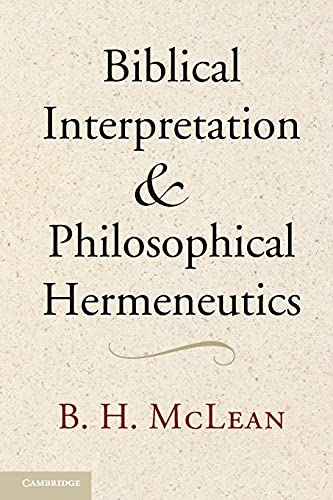
Biblical interpretation and philosophical hermeneutics / B.H. McLean.
Material type: TextPublication details: Cambridge ; New York : Cambridge University Press, 2012.Description: viii, 320 p. : ill. ; 24 cmISBN:
 - 9781107683402 (paperback)
- 220.6 23
- BS476 .M3477 2012
- REL006220
| Item type | Current library | Call number | Status | Barcode | |
|---|---|---|---|---|---|
 Books
Books
|
Ethiopian Graduate School of Theology Library Available at Circulation Section | 220.6 McL 2012 (Browse shelf(Opens below)) | Available | 11282 |
Includes bibliographical references and index.
Machine generated contents note: Preface; Introduction; Part I. The Crisis of Historical Meaning: 1. The meaning of meaning: reference, sense, meaning, and significance; 2. The death of the author; 3. The crisis of historical meaning; 4. The twilight of idols; Part II. On the Way to Post-historical Hermeneutics: 5. The interpreter as the location of meaning: Martin Heidegger; 6. Faith and history: Bultmann's debate with Bart; 7. The linguistic turn: language as a symbolizing system; Part III. Post-historical Hermeneutics: 8. Interpretation as dialogue: Hans-Georg Gadamer; 9. Interpretation and critique: Jurgen Habermas; 10. The hermeneutics of recollection and suspicion: Paul Ricoeur; 11. Interpretation before the face of the other: Emmanuel Levinas; 12. The embodied interpreter: Deleuze and Guattari; Conclusion: post-historical interpretation
"B. H. McLean proposes a new 'post-historical' method of applying philosophical hermeneutics to biblical studies"-- Provided by publisher.
"This book applies philosophical hermeneutics to biblical studies. Whereas traditional studies of the Bible limit their analysis to the exploration of the texts' original historical sense, this book discusses how to move beyond these issues to a consideration of biblical texts' existential significance for the present. In response to the rejection of biblical significance in the late nineteenth century and the accompanying crisis of nihilism, B. H. McLean argues that the philosophical thought of Heidegger, Bultmann, Gadamer, Habermas, Ricoeur, Levinas, Deleuze, and Guattari provides an alternative to historically oriented approaches to biblical interpretation. He uses basic principles drawn from these philosophers' writings to create a framework for a new "post-historical" mode of hermeneutic inquiry that transcends the subject-based epistemological structure of historical positivism"-- Provided by publisher.
There are no comments on this title.