
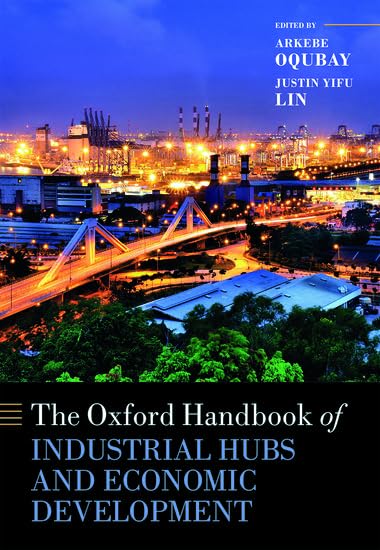
The Oxford handbook of industrial hubs and economic development / edited by Arkebe Oqubay, Justin Yifu Lin.
Material type: TextSeries: Ohbk:cPublisher: New York : Oxford University Press, 2020Description: xl, 1185 p ; 25 cmContent type:
 - text
- unmediated
- volume
- 9780198850434 (hpb)
- REF 338.9 Oxf 2020
| Item type | Current library | Call number | Status | Barcode | |
|---|---|---|---|---|---|
 Reference Books
|
Ethiopian Graduate School of Theology Library Available at Circulation Section | REF 338.9 Oxf 2020 (Browse shelf(Opens below)) | Not for loan | 21346 |
Browsing Ethiopian Graduate School of Theology Library shelves, Shelving location: Available at Circulation Section Close shelf browser (Hides shelf browser)

|

|

|

|

|
|

|
||
| REF 299.93 Hex 2002 Pocket dictionary of new religious movements / | REF 301.03 Ill 2004 Illustrated dictionary of Anthropology / | REF 305.4202 Sea 1986 Women in the world : an international atlas / | REF 338.9 Oxf 2020 The Oxford handbook of industrial hubs and economic development / | REF 338.9001 Dev 2010 The Development dictionary : a guide to knowledge as power / | REF 338.9001 Dev 2010 c.2 The Development dictionary : a guide to knowledge as power / | REF 338.9270 Gre 2011 Green education : an A-to-Z guide / |
"Industrialization, supported by industrial hubs, has been widely associated with structural transformation and catch-up in developing, emerging, and advanced economies. There are about 6,000 industrial hubs spread across 147 countries, with a high concentration in emerging and developing economies, particularly in Asia. While the direct economic benefits (such as exports, employment, outputs, and revenues) of industrial hubs are significant, their value lies first and foremost in their contribution as incubators of industrialization, productive and technological capability, and innovation, which can facilitate sustained growth and the climbing of the development ladder. The Oxford Handbook of Industrial Hubs and Economic Development adopts an inter-disciplinary approach to examine the conceptual underpinnings, reviews empirical evidence of regions and economies, and extracts pertinent lessons for policy researchers and practitioners on the key drivers of successes and failures of industrial hubs. Chapters contributed by 80 eminent authors are organized under seven themes: theories and methodologies; context and historical perspective; gender and environmental sustainability; policy and practices in Asian, Latin American, and African economies; and future pathways. The Handbook illustrates the diverse and complex nature of industrial hubs, and shows how industrial hubs promote industrialization, economic structural transformation, and technological catch-up. It explores the implications of emerging issues and trends such as environmental protection and sustainability, technological advancement, the shifts in the global economy, and urbanization. The concluding remarks emphasize the centrality of learning and latecomer advantage"-- Provided by publisher.
There are no comments on this title.