
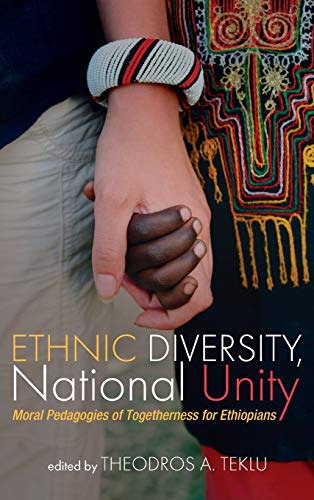
Ethnic Diversity, National Unity : Moral pedagogies of togetherness for Ethiopians / Edited by Theodros Assefa Teklu.
Material type: TextPublisher number: Center for Christianity and Society of the Ethiopian Graduate School of TheologyPublication details: Eugene, Oregon: : Wipf & Stock,, c2021.Description: 232 p ; 24 cmISBN:
 - 9781725286344 (hpb)
- ETH 320.963 Eth 2021
| Item type | Current library | Call number | Status | Barcode | |
|---|---|---|---|---|---|
 ETHIOPIAN COLLECTION
|
Ethiopian Graduate School of Theology Library Available at Circulation Section | ETH 320.963 Eth 2021 (Browse shelf(Opens below)) | Available | 21529 | |
|
ETHIOPIAN COLLECTION
|
Ethiopian Graduate School of Theology Library Available at Circulation Section | ETH 320.963 Eth 2021 c.2 (Browse shelf(Opens below)) | Available | 21574 |
"This is a thoughtful and fascinating book which addresses a question academically relevant as well as foremost in the minds of many Ethiopians today: how to reconcile the facts and feelings of ethnic diversity and its discursive representations with sources of moral thinking and action in shared spaces. . . . The various contributions break new ground and suggest that religious thinking can provide rich and unifying elements for sociopolitical discourse not only geared towards toleration but also towards acceptance of the 'Other' in an overarching framework of symbiosis and understanding that the country needs. . . . When ethnicity or, in some cases, religion are used for developing antagonism or 'enemy images, ' that is a choice; it is never a necessity or destiny. In this vein, the book offers very interesting reflections and case studies that will interest a broad readership, with crucial elements for developing a new ethical discourse of interaction, acceptance, and unity in diversity, and with the underlying view that humans are all one under the eye of the eternal and can work to realize that vision." --Jon Abbink, Leiden University "Ethnic Diversity, National Unity is a rare jewel of masterful insights on ethnopolitical cohesion for the Ethiopian context and elsewhere. The contributors creatively handle the various aspects of ethnicity, politics, and identity issues that have often been causes of hostility, prejudice, and rivalry among the various ethnic communities not only in Ethiopia but also throughout the world. The writers see the antidote of ethnopolitical violence in morality, religion, and justice. Thus, this book is relevant beyond Ethiopia. I, therefore, recommend it to those keen on understanding the aforesaid issues and finding a solution to them." --David Tarus, Association for Christian Theological Education in Africa
Although asserting one's ethnic identity is not morally wrong, the manner in which one ethnic group construes or relates to the ethnic other(s) can obliterate the bond of togetherness and create the insecurity of life. Ethiopia, which is home to anthropologically diverse ethno-linguistic groups, exhibits a proclivity to ethnic-based hostilities and conflicts. As a result of such hostilities, Ethiopia had suffered recurrent small- and large-scale deaths, and in the last half decade only millions have been internally displaced and live in dire conditions. In dialogue with perspectives from a wide range of disciplines such as history, law, sociology, philosophy, theology, and political thought, this multi-authored book aims at generating Christian moral resources for peaceful multiethnic togetherness. This interdisciplinary engagement is meant to buttress the task of interpreting ethnic diversity and national unity within both contemporary and historical Ethiopia, and articulating a Christian moral response to the crisis of togetherness ensuing from the malpractices of affirming ethnic identity and enacting national unity.
There are no comments on this title.