
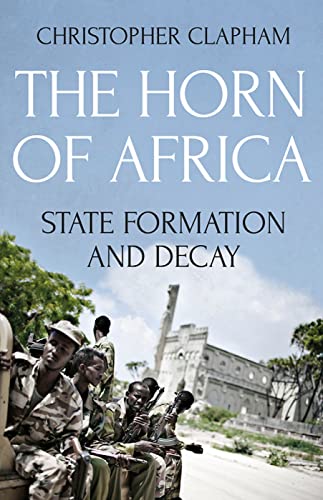
The Horn of Africa : State Formation and Decay / by Christopher Clapham.
Material type: TextPublisher: Oxford : Oxford University Press, [2017]Copyright date: ♭2017Description: xiii, 224 pages : maps ; 22 cmContent type:
 - text
- unmediated
- volume
- 9781849048286 (pbk)
- 0190680180
- Since 1900
- Politics and government
- Horn of Africa -- History -- 20th century
- Horn of Africa -- History -- 21st century
- Horn of Africa -- Politics and government -- 20th century
- Horn of Africa -- Politics and government -- 21st century
- Ethiopia -- Politics and government -- 1974-1991
- Ethiopia -- Politics and government -- 1991-
- Africa -- Horn of Africa
- Ethiopia
- AFR 963.07 Cla 2017 23
- DT367.8 .C53 2017
| Item type | Current library | Call number | Status | Barcode | |
|---|---|---|---|---|---|
 AFRICAN COLLECTION
|
Ethiopian Graduate School of Theology Library Available at Circulation Section | AFR 963.07 Cla 2017 (Browse shelf(Opens below)) | Available | 22058 |
Browsing Ethiopian Graduate School of Theology Library shelves, Shelving location: Available at Circulation Section Close shelf browser (Hides shelf browser)

|

|

|

|

|

|

|
||
| AFR 962 Tve 2016 The River Nile in the age of the British : political ecology and the quest for economic power / | AFR 962.4042 For 2013 Forging two nations : insights on Sudan and South Sudan / | AFR 963 Mar 2012 National and class conflict in the Horn of Africa / | AFR 963.07 Cla 2017 The Horn of Africa : State Formation and Decay / | AFR 963.072 Hor 2013 The Horn of Africa : intra-state and inter-state conflicts and security / | AFR 963.5 Pla 2016 Understanding Eritrea : inside Africa's most repressive state / | AFR 966.62 Hub 1998 The Liberian Civil War / |
Includes bibliographical references (pages 205-212) and index.
Acknowledgements -- List of Acronyms and Indigenous Words -- Maps -- Introduction: An African Anomaly -- 1. The Power of Landscape -- 2. Histories of State Creation and Collapse -- 3. State Reconstruction in Ethiopia -- 4. Eritrea: The Tragedy of the Post-Insurgent State -- 5. Managing Somali States -- 6. The Horn, the Continent and the World -- Notes -- Bibliography -- Index.
Why is the Horn such a distinctive part of Africa? This book, by one of the foremost scholars of the region, traces this question through its exceptional history and also probes the wildly divergent fates of the Horn's contemporary nation-states, despite the striking regional particularity inherited from the colonial past. Christopher Clapham explores how the Horn's peculiar topography gave rise to the Ethiopian empire, the sole African state not only to survive European colonialism, but also to participate in a colonial enterprise of its own. Its impact on its neighbours, present-day Djibouti, Eritrea, Somalia and Somaliland, created a region very different from that of post-colonial Africa. This dynamic has become all the more distinct since 1991, when Eritrea and Somaliland emerged from the break-up of both Ethiopia and Somalia. Yet this evolution has produced highly varied outcomes in the region's constituent countries, from state collapse (and deeply flawed reconstruction) in Somalia, through militarised isolation in Eritrea, to a still fragile 'developmental state' in Ethiopia. The tensions implicit in the process of state formation now drive the relationships between the once historically close nations of the Horn.
There are no comments on this title.