
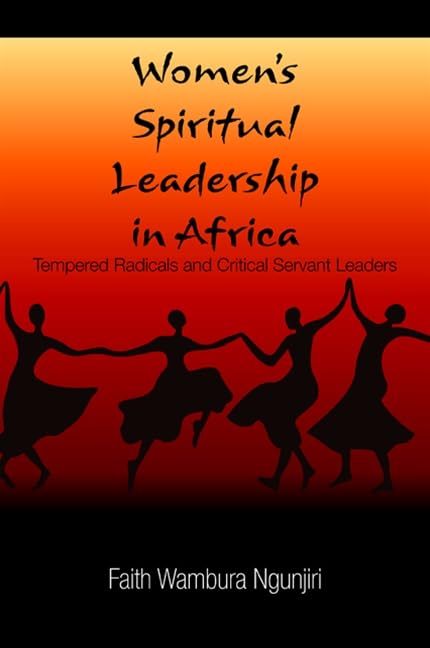
Women's spiritual leadership in Africa : tempered radicals and critical servant leaders / by Faith Wambura Ngunjiri.
Material type: TextPublication details: Albany : State University of New York Press, c2010.Description: xviii, 241 p. ; 24 cmISBN:
 - 9781438429762 (pbk. : alk. paper)
- 1438429770 (hbk. : alk. paper)
- AFR 305.4209 Ngu 2010 22
- HQ1787 .N495 2010
| Item type | Current library | Call number | Status | Barcode | |
|---|---|---|---|---|---|
 AFRICAN COLLECTION
|
Ethiopian Graduate School of Theology Library Available at Circulation Section | AFR 305.4209 Ngu 2010 (Browse shelf(Opens below)) | Available | 22093 |
Browsing Ethiopian Graduate School of Theology Library shelves, Shelving location: Available at Circulation Section Close shelf browser (Hides shelf browser)
| No cover image available | No cover image available | No cover image available |

|

|

|

|
||
| AFR 305.4207 Jaj 2014 c.2 Gender in the political arena : a training manual / | AFR 305.4209 Bas 2001 Gender, democratic practice, and member control in agricultural primary co-operative societies in Uganda / | AFR 305.4209 Mug 2000 Women's roles in armed conflict and their marginalization in the governance of post-conflict society : the case of "Luwero Triangle" / | AFR 305.4209 Ngu 2010 Women's spiritual leadership in Africa : tempered radicals and critical servant leaders / | AFR 305.4209 Pow 2009 Power, gender, and social change in Africa / | AFR 305.482 Kin 2014 Women and the informal economy in urban Africa : from the margins to the centre / | AFR 305.4889 Ama 1987 Male daughters, female husbands : gender and sex in an African society / |
Includes bibliographical references and index.
"Women's Spiritual Leadership in Africa offers portraits of sixteen African women in leadership positions in grassroots, national, Pan African and global organizations, and explores how they choose to "rock the boat without falling out" by transforming their communities and organizations from within. In her analysis of the women leaders' experiences, Faith Wambura Ngunjiri demonstrates how these African women navigate cultural and organizational challenges, including the intersecting oppressions of gender, ethnicity, class, and marital status, in order to act boldly against social and economic injustices. Ngunjiri characterizes the women as "critical servant leaders" because of their approach to leadership, where they lead through service while deconstructing patriarchal social and institutional practices and providing positive alternatives. The women's tempered radicalism and servant leadership is deeply informed by African and Christian spirituality, which animates and informs their lives and leadership experiences. Collectively, the women's stories present an important and inspiring vision of contemporary women's leadership in African contexts."--BOOK JACKET.
There are no comments on this title.