
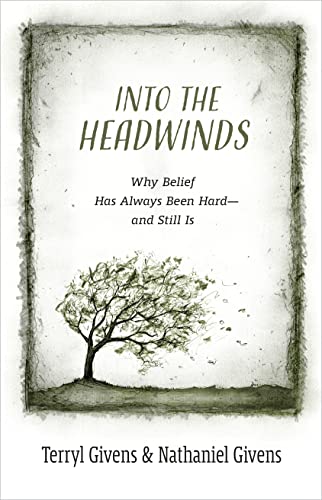
Into the headwinds : why belief has always been hard-and still is / by Terryl Givens, Nathaniel Givens.
Material type: TextPublisher: Grand Rapids, Michigan : William B. Eerdmans Publishing Company, c2022Description: ix, 132 pages ; 23 cmContent type:
- text
- unmediated
- volume
- 9780802882431
- 234.23 Giv 2022 23/eng/20220906
- BT771.3 .G556 2022
- REL077000 | PHI032000
| Item type | Current library | Call number | Status | Barcode | |
|---|---|---|---|---|---|
 Books |
Ethiopian Graduate School of Theology Library | 234.23 Giv 2022 (Browse shelf(Opens below)) | Available | 23804 |
Browsing Ethiopian Graduate School of Theology Library shelves Close shelf browser (Hides shelf browser)


Includes bibliographical references and index.
1. On Rationalism -- The Divided Self -- A New Paradigm? -- The What of Belief -- The Why of Belief -- The Source of Beliefs -- 2. On Scientism -- Science, Scientism; Reason, Rationalism -- Science Is Not Strictly Rational -- Science and Technology: An Uneven Relationship -- The Unity of Truth Seeking -- 3. On Faith -- Cultural Headwinds -- Biological Headwinds -- Psychological Headwinds -- Where Now? -- Faith and Moral Responsibility? -- Faith and Uncertainty.
"An inquiry into faith in a society of declining religious affiliation, in which the authors engage with prevailing cultural myths inimical to faith-most notably rationalism and scientism"-- Provided by publisher.
"A deeper look at how people individually and collectively form religious beliefs-and what that means for faith in a society of declining religious affiliation. Secularism is increasingly a fact of life in Western society. But that doesn't necessarily mean that faith is harder than it has been before. Even in the past when organized religion enjoyed more widespread cultural acceptance, there were still obstacles to true belief. Today, the obstacles are different, but faith is still viable. Acclaimed author Terryl Givens and his son, Nathaniel Givens, combine their respective areas of expertise to offer here a fresh take on religious belief through the lens of contemporary research on psychology, cognition, and human nature. They also address two of faith's foremost modern-day antagonists: rationalism-the myth that humans can or should make the majority of their choices based on logical thought-and scientism-the myth that science is the only reliable means of discovering truth. After reckoning with the surprising fact that people often don't even understand their own beliefs and are influenced in ways they seldom perceive, the authors go on to describe genuine faith as an act of will-an effortful response to the deepest yearnings of the mind and heart-that engenders moral responsibility, the ability to embrace uncertainty, the motivation and means to relate to others, and the capacity to apprehend reality through nonrational means. Written for truth seekers who may or may not belong to religious communities, Into the Headwinds is less a work of apologetics than an inquiry into the role that faith can and does still play in a society where participation in institutional religion is declining precipitously. Terryl and Nathaniel Givens propose that to reclaim the power of genuine faith-that which can truly offer a way of living against the grain-we need to first acknowledge the reality that religious belief is hard. It always has been, and it always will be. But perhaps, instead of a hindrance, that is its most important aspect"-- Provided by publisher.
There are no comments on this title.