
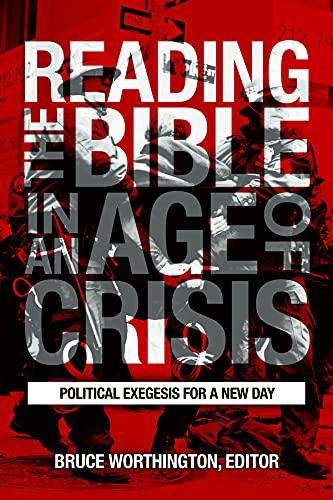
Reading the Bible in an age of crisis : [manuscript] : political exegesis for a new day / / Edited by Bruce Worthington,.
Material type: TextPublication details: Minneapolis, MN : : Fortress Press,, c2015.Description: ix, 363 pages ; ; 23 cmISBN:
 - 9781451482867 (pbk)
| Item type | Current library | Call number | Status | Barcode | |
|---|---|---|---|---|---|
 Books
Books
|
Ethiopian Graduate School of Theology Library Available at Circulation Section | 220.6 Rea 2015 (Browse shelf(Opens below)) | Available | 16696 |
Bibliography note: Includes bibliographical references and index.
Contents: Part I. Global crisis and the practice of Biblical studies. Introduction : political exegesis for a new day / Bruce Worthington -- Reading the Bible with the poor : building a social movement, led by the poor, as a united social force / Liz Theoharis and Willie Baptist -- Occupying my desk / Neil Elliott -- Solidarity! : conditions apply / Christina Petterson -- Part II. Global crisis and the First Testament. On the feasibility of subsistence economics / Roland Boer -- Occupying the Temple in ancient Judah : resisting debt abuses, from Jerusalem to Wall Street / Matthew J.M. Coomber -- The global crisis of debt in context : biblical and postcolonial reflections on the ideology of empire / Robert Wafawanaka -- Food, power, and ecological hermeneutics : reading Joseph with Monsanto / Gregory P. Fewster -- Part III. Global crisis and the Second Testament. Homelessness, neoliberalism, and Jesus' "decision" to go rogue : an analysis of Matthew 4:12-25 / Robert J. Myles -- Romans 13:1-7 : with an eye to global capital / Bruce Worthington -- Occupy Solomon's portico : on the community of goods in the longue dureþe / Jonathan Bernier -- On trying to praise the mutilated world : reading Revelation in the midst of ecological crisis / Ryan L. Hansen -- Why bother with biblical studies? / Richard Horsley. Summary: We live in an age in which economic, ecological, and political crises are not the exception, but the rule. The Cold War polarities that shaped an earlier "political exegesis" have been replaced; Bruce Worthington argues that increasingly, crisis is the engine of a global "turbo-capitalism." In this volume, edited by Worthington, biblical scholars and activists describe and exemplify the shape of a biblical interpretation that takes contemporary crisis seriously as its most important context. Succinct opening essays summarize the salient aspects of our critical situation, especially in relation to the dominance of capitalism and its pervasive values; in later parts, contributions address themes of economic, political, and environmental crisis in dialogue with texts from the First and Second Testaments. Throughout the volume, the authors are careful to describe the basis for making interpretive analogies across historical, cultural, and socioeconomic distances between the world of the Hebrew Bible, the New Testament, and our own. Richard A. Horsley writes a postscript pointing to next steps in political interpretation.
There are no comments on this title.